Running out of battery during a commute or trip is frustrating, especially when phones are needed for tickets, maps, payments, and urgent calls. A good power bank solves this, but many buyers get confused by capacity numbers, ports, and fast-charging labels and end up with bulky bricks or weak units that barely charge once. This Alex Top Finds guide explains the most important things to check—capacity, output power, ports, safety, and size—so that students, professionals, and frequent travelers can pick a power bank that fits their real-life usage instead of just going by big marketing claims.
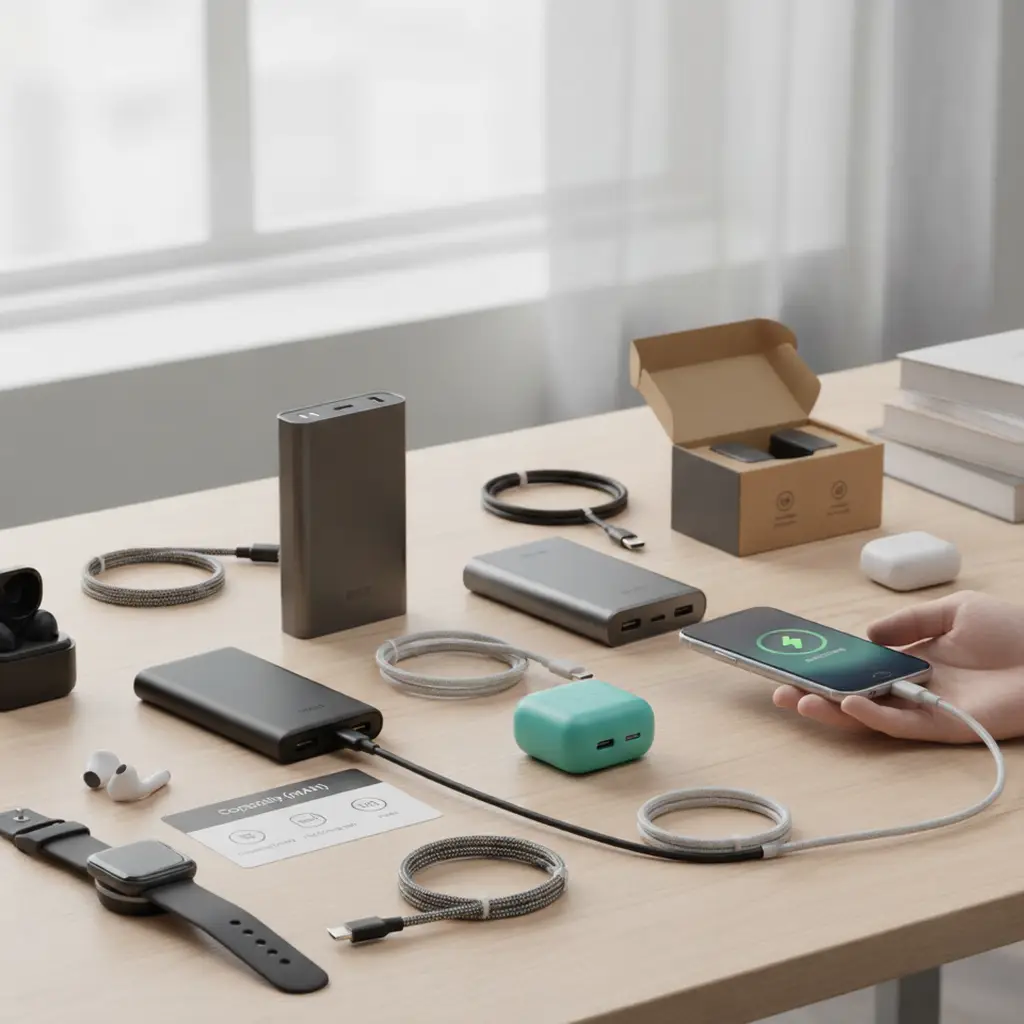
Understand Capacity and How Many Charges You Need
Capacity is measured in milliampere-hours (mAh) and tells you roughly how much energy the power bank can store. For daily commuting with one smartphone, a compact 10,000 mAh unit usually gives 1.5–2 full charges depending on your phone’s battery size. For travel days, long events, or multiple devices, 20,000 mAh is more practical because it offers several top-ups before you need to recharge the bank itself. Always remember that real usable capacity is lower than the printed number due to conversion losses, so it is safer to pick slightly higher than your minimum requirement.
Check Output Power and Fast-Charging Support
Output power is mentioned in watts (W) or as volts and amps (for example, 5V/3A). Higher output allows faster charging for phones and tablets that support it. If your phone supports fast charging, look for ports that can deliver 18 W or more so you are not stuck with slow top-ups when you are in a rush. For basic users who mainly charge overnight or casually on the go, standard 10 W outputs are usually sufficient, but combining one fast port and one normal port offers flexibility.
Look at the Number and Type of Ports
Most power banks now offer a mix of USB-A and USB-C ports for compatibility with older and newer cables. If you carry more than one device—like a phone and wireless earbuds—having at least two output ports lets you charge both at the same time. USB-C ports that work for both input and output are very practical because you can use the same cable to charge the bank and your devices, reducing the number of cables in your bag.
Choose the Right Size and Weight for Your Lifestyle
Larger capacity almost always means more weight and bulk, so it is important to balance power needs with portability. For people who keep a power bank in a handbag or small backpack for daily office commutes, a slim model that fits in the same pocket as the phone is more convenient than a thick high-capacity block. Frequent travelers who rely on the bank as a backup all day may accept extra weight if it means charging phones, tablets, and earbuds without finding a wall socket often.
Consider Build Quality and Design
Good build quality helps the power bank withstand daily drops, bumps in bags, and repeated plugging in and out. A solid outer shell, tight ports, and stable buttons are signs of better construction. Textured or rubberized surfaces improve grip and reduce the chance of slipping from hands or smooth tables during use in buses or trains. Simple, clean designs with clear, easy-to-read indicators also make it easier to check status quickly during a busy day.
Check Safety Features and Certifications
Safety is essential when carrying a battery in your bag all day. Look for common protections such as overcharge protection, short-circuit protection, and temperature control mentioned in the product details. Certifications from recognized testing standards increase confidence that the power bank has been tested for safe operation and is less likely to overheat or malfunction when used as directed.
Understand Input Power and How Fast the Bank Recharges
Many people focus only on how fast the bank charges devices and forget to check how fast the bank itself can refill. A power bank that supports higher input wattage through USB-C will recharge much faster than one limited to older, slower standards. This is particularly useful on trips: if you only have access to a wall socket for a short time, a fast-recharging power bank will be ready to serve you again sooner.
Match the Power Bank to Your Devices
Before buying, list the devices you actually want to charge: smartphones, earbuds, smartwatches, or tablets. Ensure the power bank can support the total number of devices and their charging needs without being overkill. For example, if you mostly charge a single smartphone and a pair of earbuds, an ultra-high capacity unit might be unnecessary; a medium-sized model with two ports is more efficient and lighter to carry.
Think About Airline and Travel Rules
If you plan to fly, it is important to know that airlines usually only allow power banks in hand luggage and within certain capacity limits measured in watt-hours (Wh). Most 10,000–20,000 mAh consumer power banks fall within common limits, but extremely large models may not be allowed. Keeping the capacity within normal travel ranges ensures you can pass security checks smoothly and use your power bank at airports and on planes when regulations permit.
Budget, Warranty, and Brand Reliability
Finally, consider your budget and the level of reliability you expect. Many reasonably priced power banks offer solid performance, but choosing trusted brands with proper warranties often pays off in the long run. A clear warranty, accessible customer support, and consistent quality help avoid early failures, swelling batteries, or unreliable performance after a few months of use. For a device that protects and powers your phone, paying slightly more for safety and stability is often a sensible decision.